Fellow loot goblins, let's be real: 2026 is already here, and if I open my character storage one more time only to be greeted by 487 crafting mats, three types of 'legendary' boots that aren't even legendary, and a quest item from an expansion I finished in 2023, I'm going to uninstall life. So I made a resolution—a gamer's resolution—to declutter my digital hoard. That's when the boundary method tiptoed into my feed. At first I side-eyed it like a suspicious loot box. No fancy add-ons? No spending premium currency on extra stash tabs? It almost felt too simple. But then I remembered my overflowing vault in Elden Ring 2, my stuffed glamour dresser in FFXIV, and the 12 copies of a common sword I absolutely do not need in Genshin Impact. Desperate times call for desperate measures.
 :max_bytes(150000):strip_icc():format(webp)/boundary-method-step-four-2-f471c7e5dbc84653b4bbaba33a032724.jpg)
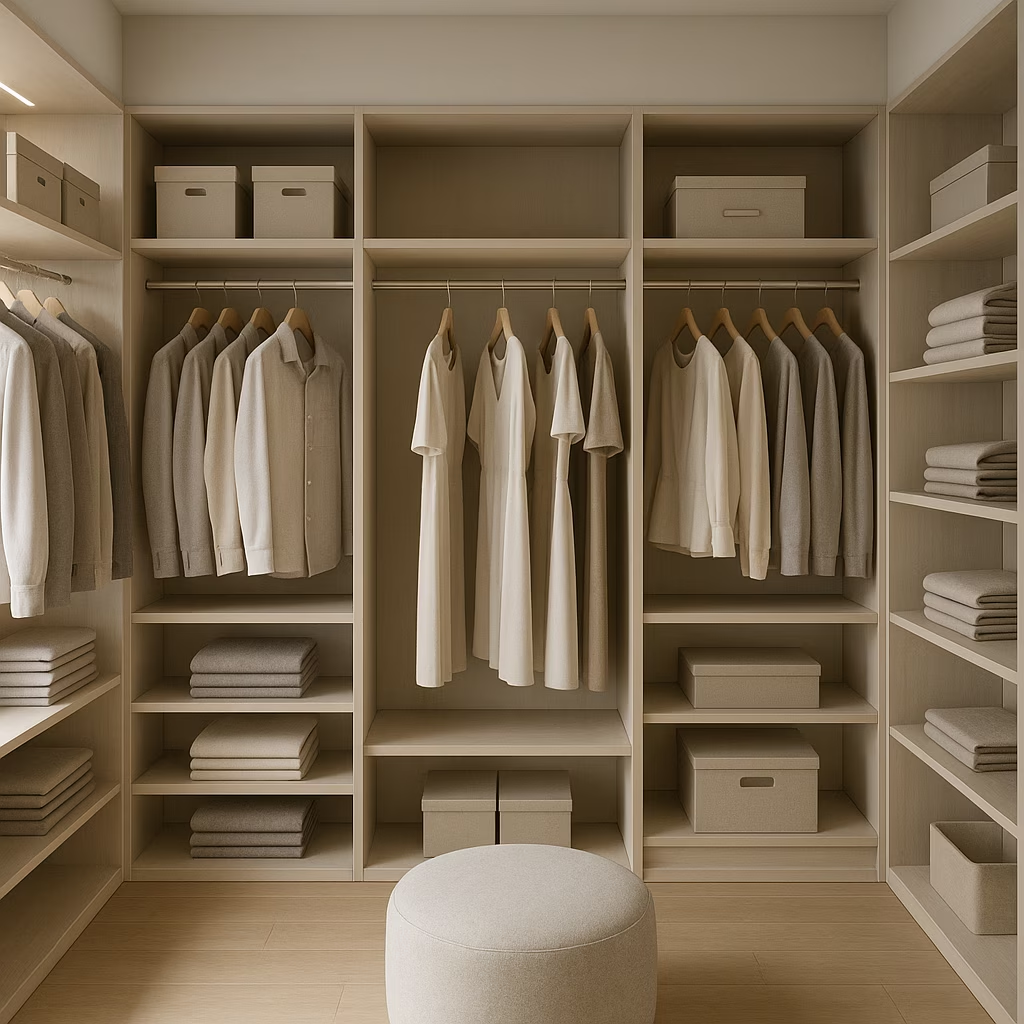
The boundary method—also called the container method—isn't some arcane ritual you need a PhD in KonMari to understand. I discovered it through Erica Lucas, an organization expert whose video made me feel less alone in my cramped digital spaces. Yes, she talks about actual drawers and shelves, but I heard 'inventory slots' and 'stash tabs.' Lucas says the boundary method forces you to limit the number of items you keep by defining a physical boundary—a shelf, a drawer, a basket. Translate that to gamer-speak: a specific backpack page, a bank tab, or even a single row in your equipment screen. The physical limits of that container become the rule. No exceptions. No 'but what if I need this grey item later???' Later never comes.
What I love about this approach is how it differs from other decluttering philosophies you've probably tried and failed. The 90/90 rule? 'Have you used it in the last 90 days?' Buddy, I haven't used half my emotes in 900 days. The Marie Kondo method ('does it spark joy?') is adorable until you realize that a pile of 43 shiny rocks from an MMO sparks nothing but existential dread. The boundary method sidesteps all that emotional calculus. It's brutally simple: If it doesn't fit in the space you've defined, it's got to go. No joy-checking required—just cold, hard geometry.
🎮 Where the Boundary Method Shines in Gaming
Lucas says this method works almost anywhere in a real home, but she mentions toys, board games, books, and kitchen utensils as prime candidates. In our world, that translates to:
-
Cosmetic items and skins – you don't need 47 weapon skins for a gun you stopped using three seasons ago.
-
Crafting materials – if you can't donate them, at least sell them. Your 800 iron ore is just virtual dust.
-
Consumables you hoard 'for the final boss' – and then never use even on the final boss.
-
Quest items – I'm looking at you, Key to a Basement Somewhere from 2024.
-
Duplicate gear – two sets of the same armor that differ only by 0.3% stats? Pick one.
Before tackling my library of unplayed Steam games (that's a boundary for another day), I started with something less emotionally fraught: my pants drawer. Wait—I mean my pants equipment slot in an RPG I'm currently no-lifing. The dresser in my apartment has shallow drawers that always end up looking like a goblin rummaged through them. Worse, my in-game gear often ends up with random low-level pants I picked up 'just in case.' Same energy.
Step 1: Empty the Boundary Completely
Lucas's first move—and mine—was to yank everything out. Remove every single item from the drawer, shelf, or in this case, every piece of leg armor from my dedicated pants bag. No exceptions. Suddenly I could see all my sins at once. Oh look, a 'Tattered Breeches of the Fool' I'd been saving for nostalgia. A pair of level 10 pants in my level 85 character's inventory. And—whoops—a sweater! Metaphorically, that's like finding a fishing pole in your weapon slot. If it doesn't belong, evict it immediately.
Step 2: Create Piles (Keep, Toss, Misplaced)
Once you've spilled your guts onto the proverbial floor, make three piles:
-
Keep: the pants that actually fit your build and your fashion sense.
-
Donate/Sell/Dismantle: anything that's under-leveled, ugly, or hasn't been equipped since Carter was president.
-
Misplaced: items that accidentally wandered into the wrong boundary, like that sweater or a shield hiding among your two-handed swords.
I found jeans I hadn't worn in years—digitally speaking, leggings with stats for a build I never played. Pants with tags still on them, purchased from a vendor during a late-night sale frenzy that never fit my style to begin with. Sound familiar? My finger hovered over the 'keep' pile for a pair with perfect rolls… from three patches ago. The boundary method whispers: if it no longer serves you, set it free (or turn it into crafting dust).
Step 3: Arrange Neatly—No Shoving Allowed
Here's the real test. Lucas says you must neatly arrange or fold items so they fit comfortably within the boundary. No cramming the drawer shut with your knee, no worrying about a shelf spilling over. For us, that means no stacking items until the UI glitches, no hiding stuff in sub-bags, no exploiting a bug that lets you exceed the slot limit. Only fill the container to a level where you can see everything at a glance. If your equipment page looks like a Tetris board on hard mode, you've failed.
In my pants drawer (the real one, though it applies equally to the game), this meant folding jeans Kondo-style so I could see every pair. In my equipped inventory, I kept only the two pants I actually use—one for PvE, one for fashion. The rest? Scrapped, sold, or gifted to a low-level friend who still thinks green-quality gear is epic.
Lucas's wisdom rang in my ears: 'To own less, you have to want less; the boundary method helps you decide which items are your favorites to keep.' In my game library, that now means one outfit that makes me smile, one mount that doesn't clip through the ground, and zero clutter.
:max_bytes(150000):strip_icc():format(webp)/boundary-method-step-four-2-f471c7e5dbc84653b4bbaba33a032724.jpg)
Step 4: Return Misplaced Items to Their Homes
That sweater? Send it to the sweater drawer. The fishing pole that was in my potion belt? Back to the tackle box. In gaming terms, this is where you straighten out cross-contaminated inventory—like when you accidentally stored arrows in your soulstone bag. Re-homing stray items not only tidies up but also reminds you what each boundary is actually meant to hold. Lucas would approve.
What Changed (Besides My Sanity)
After applying the boundary method to my virtual luggage, the difference was immediate. Opening my inventory no longer triggers a mini panic attack. I can find my main weapon without scrolling past 30 vendor-trash pieces. The mental load of 'should I keep this?' has been replaced by a simple question: 'Does it fit in the boundary?' If not, it's out. The same principle now governs my potion slots, my material storage, even my desktop folder of unplayed games. One boundary at a time.
Gamers, we're conditioned to hoard. Every RPG teaches us that a rat tail might be useful later. But honestly? It won't. The boundary method is like a hardcore mode for your stuff: limited inventory, no excuses. Lucas says that mentally and physically having a boundary prevents clutter from invading down the road, and she's right. A week later, my pants drawer is still tidy, my glamour dresser still sparks joy, and my character sheet looks like it belongs to a functional adult rather than a magpie with a hoarding problem.
If you've ever spent an entire gaming session just managing your bag space, do yourself a favor. Pick one boundary—a single bank tab, one backpack, a weapon rack—and ruthlessly enforce it. You'll hate it for five minutes, then wonder why you didn't do it sooner. After all, the best loot isn't the pile you keep; it's the peace of opening a clean inventory and actually finding what you need.
Now if you'll excuse me, I have a Boundary Method: Steam Library Edition to start. Wish me luck.